Twelve days. That is all it took for one of the most dramatic corporate reversals in tech history to play out, land, and immediately get swallowed whole by the internet's meme machine. On Monday 23 November 2026, Nvidia reinstated Jensen Huang as CEO after a resignation, a board that had publicly sworn he was not coming back, and enough corporate drama to fill a decent miniseries. By the time Wall Street had finished reacting, social media had already canonised him.
The Comeback Nobody Was Supposed to See
What made the reinstatement so electric was not just that Huang was back. It was that the board had already told everyone he would not be. Twelve days of corporate chaos, an independent investigation still open, and a public statement that reportedly ruled him out entirely. In that context, the reversal was not a comeback so much as a full resurrection, and the internet reached for exactly that word within hours.
Nvidia said the board voted unanimously after talking directly with Huang and after input from senior US officials, with the conclusion that his return posed no national security risk. That detail matters. The whole drama had not simply been about internal politics. There were reports of a foreign intelligence effort involved somewhere in the story, and the independent investigation into those reports remains open even now. Nvidia also announced it would hire a chief compliance officer and strengthen its national security oversight. So the drama is not entirely closed. But Huang is back in the chair, and that is what the internet chose to celebrate.
Wall Street delivered its verdict in the clearest possible language: Nvidia shares surged nearly 35% on Monday. That kind of single-day move for a company of Nvidia's size is not a fluctuation. It is a statement. The rally also helped lift other AI stocks after what had been a rough period for the sector, which tells you just how much the market had tied the company's future directly to its founder.
GPU Jesus and the Meme Industrial Complex
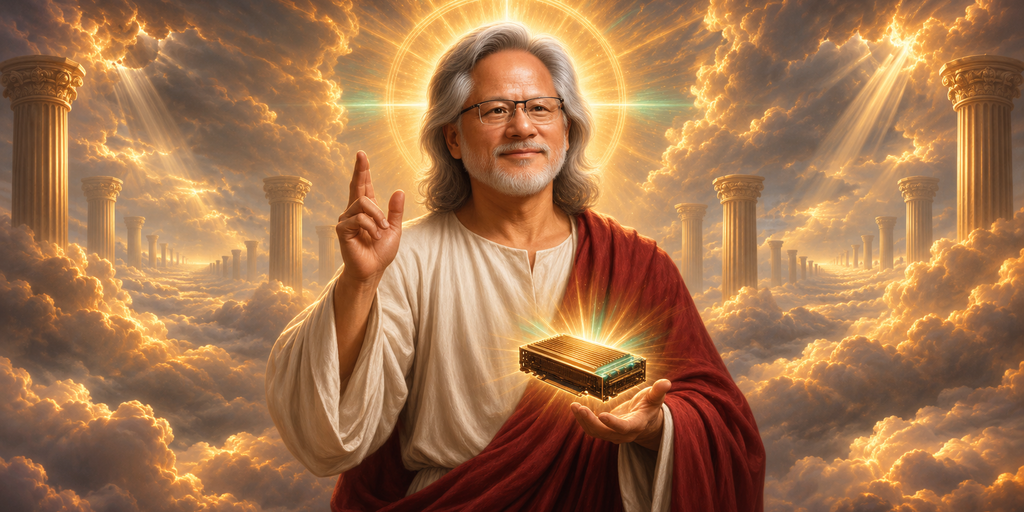
Investor Jason Calacanis set the tone early. His post "Christós anésti! GPU Jesus has risen!" captured exactly the register the internet had been looking for, and it spread fast. By any measure, the religious framing was apt. Here was a figure who had been removed, mourned, and then returned, with the market treating the whole event like a second coming. The leather jacket stays on. The GPU throne is reclaimed.
Matthew Berman had predicted before the announcement that the comeback memes were going to be incredible. Within hours of Nvidia making it official, his estimate looked modest. The internet did not just make a few jokes. It built an entire cinematic universe around the moment. AI video tools meant that creators could pull from Hollywood and remix it in real time, and they went at it properly.
The Wolf of Wall Street was an obvious choice: a character who refuses to be pushed out, whose defiant return becomes the whole point of the story. That energy mapped cleanly onto what had just happened. Others borrowed Michael Jackson concert footage, the idea being that Huang's fans were the adoring crowd greeting him back onstage. These were not throwaway posts. They were fully produced pieces of content, generated quickly enough to feel like a live reaction, but polished enough to actually land.
The Undertaker's Entrance and the Villain Casting
The wrestling community found even better material. The Undertaker's trademark resurrections, the whole mythology of a figure who keeps coming back from the dead, had been built for exactly this kind of moment. WWE edits spread quickly, and they did more than celebrate the comeback. They introduced a villain.
Anthropic CEO Dario Amodei became the internet's chosen antagonist, a casting decision that drew on an online rumour claiming he had lobbied against Huang because Nvidia's support for open-weight AI threatened Anthropic's business model. Open-weight models make their underlying parameters available for others to download and use, which is precisely the kind of competition that a closed-model company would rather not face. There is no public evidence that Amodei played any role in Huang's initial departure, and Anthropic has explicitly rejected calls for a blanket ban on open-weight models. None of that stopped the memes.
The "Sir, the boogeyman has returned" format, turning a famous moment from political history into a warning delivered to Amodei's character, summed up the internet's position neatly. The gag had a simple premise: Huang's rivals should start worrying again. The two executives represent genuinely different visions for how powerful AI should circulate, and the internet had already decided which side it was on. It is worth noting that [Claude's recent claimed breakthrough on the Riemann hypothesis](/uprise/crypto/claude-claims-historic-math-breakthrough-one-day-after-anthropic-ipo) had already made Anthropic a figure of intense online scrutiny, so the villain casting landed in fertile ground.
Jim Cramer Did It Again
You cannot tell this story without Jim Cramer. Just one day before Nvidia's biggest single day in its stock history, Cramer ran an entire segment arguing that the stock's selloff was about to get significantly worse. The timing was so perfectly catastrophic that it crossed over from bad call into performance art. The internet, naturally, treated it as such.
Memes noting Cramer's bearish turn appeared alongside the stock surge, with creators pointing out that his going negative had effectively triggered one of the market's most dramatic reversals. One post called it clockwork. That framing is a bit unfair, obviously, but that is not really the point. Cramer as reverse indicator has become a running narrative in financial social media, and Monday gave the whole bit its biggest stage yet. When a chipmaker's stock jumps nearly 35% the morning after you've called the bottom of its collapse, you are going to hear about it.
The Repentance Queue
It was not just Cramer in the stocks. Social media users built out an entire culture of mock accountability around Huang's return. Anyone who had sold Nvidia shares too early, dismissed the AI boom as hype, or treated GPUs as toys for gaming rather than the infrastructure of a technological shift was invited to reflect on their choices.
One creator went further, making the repentance process official with a mock form for confessing those offences. It was absurd and extremely funny, and it also gestured at something real: the speed at which the consensus had shifted. The people who called the AI chip story wrong in the last few years have watched Nvidia become one of the most significant companies on earth, and Monday's rally was another reminder of exactly how wrong that call was. [Saylor bought dips others ran from](/uprise/crypto/strategy-buys-30m-in-bitcoin-moves-1b-from-usd-reserve) and got mocked for it too, right up until the moment he did not. The internet has a long memory for these things, and it enjoys the receipts.
What This Actually Means Beyond the Memes
Sam Altman posted "Jensen!" OpenAI's CEO keeping it to one word said everything about the relief in certain parts of the AI world. Elon Musk wrote that "the mistake has been corrected." Donald Trump praised the reinstatement. The range of people lining up to welcome Huang back told you something about how central Nvidia had become to the whole AI infrastructure conversation, and how much of that depended on the man in the leather jacket specifically.
The investigation is still open. The compliance officer has not been hired yet. The national security questions that underpinned the entire drama have not gone away. But the board voted unanimously, the officials gave the green light, and the market responded with a 35% surge. The serious governance questions will be worked through over the months ahead, and that work matters. For now, though, the internet wanted a resurrection story, and Jensen Huang gave it one. GPU Jesus has risen. The meme parade is over. The job starts again.