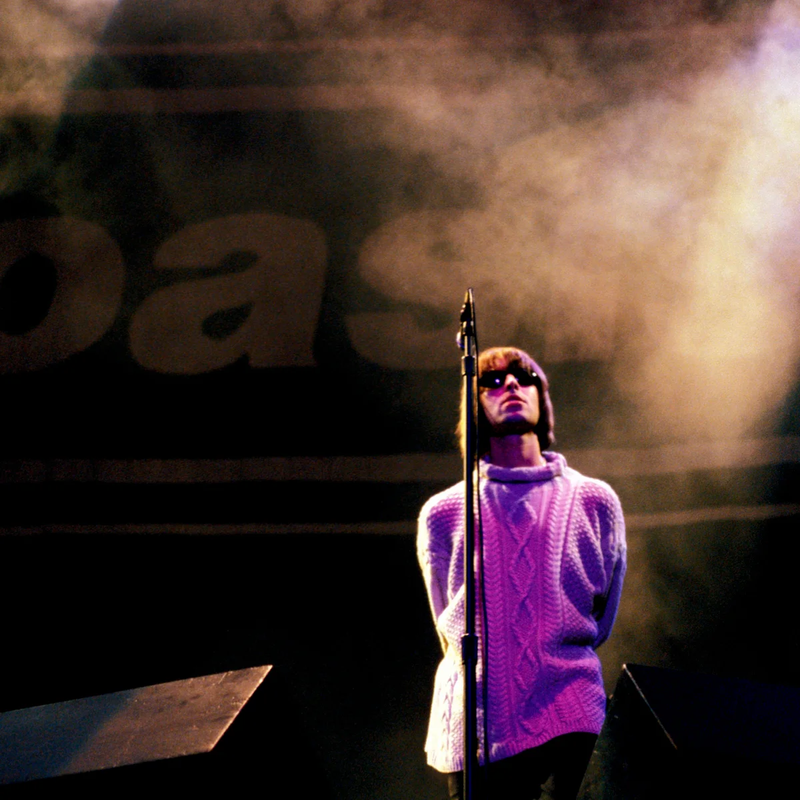
There are moments in British cultural history that transcend the events themselves and become something else entirely: shared mythology, collective memory, a fixed point that a generation returns to when it needs to remember what it felt like to be young and certain about something. Knebworth on 10 and 11 August 1996 is one of those moments. Two hundred and fifty thousand people across two nights, Liam Gallagher hands behind his back leaning into a microphone, Noel carrying that Union Jack guitar, John Squire walking out for the encore, and 125,000 voices turning every song into something that sounded less like a gig and more like a declaration. Thirty years on, with Oasis announcing a 2027 return to the same ground, it is worth going back properly, not just to celebrate the spectacle but to understand exactly how those two nights came to mean so much.
This Was Not An Accident
The story that gets told about Knebworth is usually a simple one: band gets big, band plays enormous field, legend is born. The truth is more interesting and considerably more deliberate. By the summer of 1996, Oasis had spent two years systematically dismantling every ceiling they encountered. 'Definitely Maybe', released in August 1994, arrived not with a polite knock but with the attitude of a band that already considered itself enormous. 'Rock 'n' Roll Star', 'Live Forever', 'Supersonic', 'Cigarettes and Alcohol': these were not songs auditioning for a place in British rock. They were songs written by people who had already decided they owned it.
Then came '(What's the Story) Morning Glory?' and everything shifted scale again. 'Wonderwall', 'Don't Look Back in Anger' and 'Champagne Supernova' left the indie faithful behind and reached a mass audience that had no particular interest in guitar movements or music press tribalism. They just knew these were songs that sounded like something important. By early 1996, Oasis were not competing with anyone. Earls Court in November 1995 had already shown how fast the rooms were expanding. What came next was not accidental escalation. It was a sequence, and it had been thought through.
Maine Road: Where It Got Personal
Before Knebworth, there was Maine Road. On 27 and 28 April 1996, Oasis played the former home of Manchester City, the ground that Liam and Noel Gallagher had grown up dreaming about from their home in Burnage. Around 40,000 people each night, Manic Street Preachers and Ocean Colour Scene in support, Noel already carrying that Union Jack Epiphone Sheraton that had become inseparable from the whole era. The numbers were extraordinary but the meaning of the shows ran deeper than any statistic.
This was Oasis returning to Manchester not as local lads who had done well, or even as chart stars with a few hits to their name, but as a band with the authority to occupy the physical space of their own childhood. There is something almost impossibly cinematic about that, two brothers from Burnage filling the stadium their city had always treated as sacred ground. If any moment before Knebworth captured what the whole Oasis story felt like from the inside, it was probably standing in that crowd on one of those April nights, watching a frontman who appeared constitutionally incapable of self-doubt lead 40,000 of his own people through songs they had already claimed as their own.
Loch Lomond and the Gathering of the Tribes
Three months later, Oasis travelled to Balloch Castle Country Park on the banks of Loch Lomond for two nights and approximately 80,000 people. If Maine Road was the homecoming, Loch Lomond proved something slightly different and arguably more significant: that the phenomenon did not belong to Manchester alone. Scotland had its own particular stake in the Oasis story, given that it was at King Tut's Wah Wah Hut in Glasgow back in May 1993 that Alan McGee first offered the band a deal with Creation Records. Three years later, almost to the month, they came back and filled a landscape.
The supporting cast at Loch Lomond tells you everything about what 1996 actually sounded and felt like: Manic Street Preachers, Ocean Colour Scene, Cast, Black Grape, Heavy Stereo, Dreadzone, The Bootleg Beatles. That lineup was not random. It brought together melodic guitar pop, the loose funk of post-Madchester, and the dance culture that had reshaped British music through the late 1980s and early 1990s. It was, as the source puts it, a gathering of the tribes. And the set Oasis played, running from 'Columbia' through 'Wonderwall', 'Don't Look Back in Anger', 'Live Forever' and 'Champagne Supernova' into 'I Am the Walrus', already had the shape and weight of what Knebworth would become. They even debuted 'My Big Mouth' and 'It's Gettin' Better (Man!!)' from what would become 'Be Here Now', louder and more excessive than anything before them, and at Loch Lomond that ambition still sounded thrilling rather than bloated.
The Queue That Began Before the Internet
Tickets for Knebworth went on sale at 9am on 11 May 1996, priced at £22.50 each. This was before digital queues, before mobile ticketing, before a number on a screen told you how long you had left to wait. People queued physically, they stayed on hold, they showed up. The fact that it was also the day Manchester United beat Liverpool in the FA Cup final is the kind of detail you could not make up, two enormous pieces of Manchester history colliding on the same Saturday in a way that felt entirely in keeping with the absurdity and intensity of the whole period.
The demand for those tickets was not simply evidence of how popular Oasis had become. It was evidence of what the band represented to people in the mid-1990s. [Noel Gallagher has since spoken about how working class kids can no longer afford to become rock stars](/uprise/culture/noel-gallagher-working-class-kids-cant-afford-to-become-rock), and there is something worth sitting with in the contrast between that £22.50 ticket price and what concerts cost today. Knebworth was accessible. It was enormous but not exclusive. A quarter of a million ordinary people got in across two nights, and that fact alone shaped what the whole thing meant.
The Night History Happened
When the moment finally arrived on 10 August, Noel stood before the crowd before the second show began and said: "This is history, this is history. Right here, right now. This is history." Liam, with the instincts of someone who could deflate any pretension in a single sentence, immediately responded: "I thought it was Knebworth." That exchange, right there, is the whole band in two lines. Noel always understood the scale and the symbolism, always had one eye on what the moment meant beyond itself. Liam refused to let anything become too grand, too reverent, too pleased with its own significance.
What made Knebworth genuinely historic was not purely the size of the crowd, although 250,000 people across two nights is a number that still sits heavily. It was the convergence of things that only happens once. The commercial peak of Britpop, the optimism that 1996 Britain was projecting about itself, the particular hunger that Oasis had been feeding since 'Definitely Maybe', all of it arriving in the same field at the same time. The [culture that surrounded British music at that exact moment](/uprise/culture/10-amazing-music-guests-who-prove-tfi-friday-ruled-1990s) was one of unusual confidence and community, and Knebworth was its single biggest expression.
Thirty Years Later, and Why It Still Matters
When Oasis announced their return to Knebworth as part of a 2027 tour, the response was immediate and enormous, which tells you something. This is not nostalgia for its own sake. It is recognition of something that genuinely mattered: a band that emerged from working class Manchester and, within the space of roughly two years, played to a quarter of a million people in a field in Hertfordshire and made every one of them feel like they were watching something that belonged to them personally.
The broader cultural context around [how 1990s Manchester music shaped identity and style](/uprise/culture/how-80s-and-90s-manchester-music-changed-male-fashion--) did not begin and end with Oasis, but Oasis were its loudest and most visible expression. And Knebworth was the high watermark. Whether the 2027 shows can capture anything of that original charge is genuinely impossible to know. What the anniversary makes clear is that the 1996 concerts were not simply large events that sold a lot of tickets. They were the moment when a band, a movement and a cultural mood all reached their peak at the same time, in the same place, and had the good sense to leave behind an image of it that thirty years of retrospect has not managed to diminish. Noel was right. It was history.