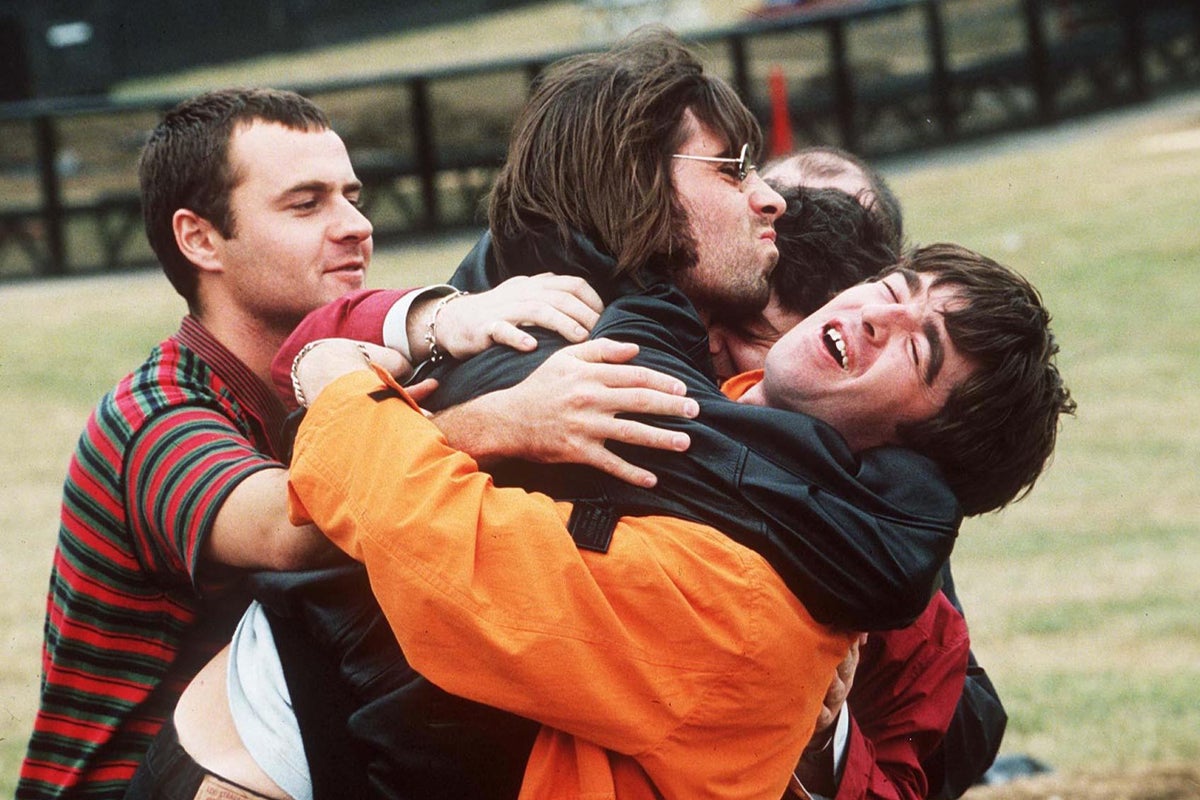
There is a version of the Nineties that gets cleaned up and sold back to us as nostalgia: the haircuts, the lad mag covers, the Sunday supplement retrospectives. Knebworth 1996 was not that version. Knebworth was 250,000 people descending on a Hertfordshire stately home across one August weekend, fuelled by the particular recklessness of a generation that had been handed a cultural moment and decided to absolutely rinse it. It was, by official count, the biggest live event in the history of British rock. And thirty years on, with Oasis preparing to return there as part of their 2027 world tour, it is worth sitting with what actually happened, what it meant, and why nothing has come close since.
The Weight of the Number
Start with the figure, because it earns its keep. Two hundred and fifty thousand people. Not spread across a weekend festival on separate stages with different headliners, not accumulated across a national tour. Two hundred and fifty thousand people, at the same venue, for the same band, across two consecutive nights. For context, that demand was barely the surface of what existed. According to Chris York, one of the show's co-promoters, two million ticket requests were logged, while the phone lines registered ten million calls. Ten million. On phone lines. Because the internet did not exist as a ticket-buying mechanism in any meaningful sense. People rang. People waited. People camped outside venues overnight for the chance to be there.
What that number tells you is not just that Oasis were popular. Plenty of bands are popular. What it tells you is that Knebworth had taken on a meaning beyond the music before a note was played. York puts it plainly: even casual fans wanted to be there because it was a seismic moment on the timeline of Nineties music. People understood, collectively and instinctively, that they were watching something crystallise. You did not need to know every word of "(What's the Story) Morning Glory?" to feel that pull. Culture does that sometimes. It generates a gravity of its own.
How a Band Gets That Big, That Fast
The trajectory was almost comically steep. Oasis had been signed just three years before Knebworth. Three years. Alan McGee, head of Creation Records, recalls thinking that Manchester City's Maine Road, where the band played a stadium show in April 1996, was probably the ceiling. Their home city, their beloved club's ground, a full stadium: that ought to be the pinnacle. It sold out in what McGee describes as roughly two minutes, on phone lines alone, and the second night followed suit the next day. At that point, someone in that conversation ought to have recognised that the ceiling had already been blown off.
The fuel for all of this was "(What's the Story) Morning Glory?", which eventually shifted 22 million copies worldwide and sits as the fifth best-selling album in UK chart history. But momentum of that scale does not come from sales figures alone. It came from the cultural context the album landed in. The so-called Battle of Britpop, the August 1995 chart race between Blur's "Country House" and Oasis's "Roll With It", had captured the public imagination in a way that genuinely had not been replicated since the Beatles and the Rolling Stones were treated as rival camps. Blur won the singles race. Oasis won everything else.
Finding the Right Field
The logic of how Knebworth became Knebworth is worth understanding, because it was not accidental. After Maine Road confirmed the demand was real and still growing, a group comprising the band, management, agents and promoters essentially went on a tour of southern English fields looking for somewhere big enough to make a statement. York says the capacity was one of the driving factors: the band wanted to make clear what they were. Knebworth was the last venue they viewed, and by York's account, the moment they walked in, it felt right. There was also a specific cultural weight to the venue itself, that sense of it being where rock legends played, and of Oasis seeing themselves as the next in that line.
The timeline was, by any modern standard, absurd. Tickets went on sale in May for shows in August. Three months. York calls it "ridiculously short" and "very ballsy," noting that bands simply do not sell like that on those timelines. Oasis did. Every ticket sold either in person at a physical outlet or to someone who stayed on a phone line long enough to get through. That detail matters. This was not passive consumption. People worked for those tickets.
The Bill That Matched the Moment
Whatever your feelings about Oasis as headliners, the supporting bill assembled for those two nights is a genuine artefact of a very specific cultural moment. The Prodigy, the Manic Street Preachers, the Chemical Brothers, the Charlatans: you are looking at a lineup that could headline arenas in its own right, stacked onto the undercard of one event. [The Charlatans](/uprise/culture/the-charlatans-totp-rewind-the-90s) alone carried a decade's worth of musical credibility onto that stage. McGee's assessment is simply that it was probably as good a bill as that era could produce.
At the bottom of the bill, still soundchecking when the gates opened on Saturday, were the Bootleg Beatles, who had a small orchestra in tow for "All You Need Is Love" and "Hey Jude." Andre Barreau, their George, described looking up from the stage to see what he called a tidal wave of kids from four counties away, moving like ants toward the site. The Chemical Brothers, by contrast, found that when they took the stage, the audience was still singing the "Na-na-na" refrain from the Bootleg Beatles set. There is something almost poetic about that. Even in the shadow of Oasis at their absolute peak, the Beatles could still hold an audience hostage.
What Britpop Actually Was
It is easy, thirty years out, to reduce Britpop to a vibe: parkas, guitar riffs, lads. But Jake Scott, director of the documentary and concert film "Oasis Knebworth 1996," describes something more electric than that. He talks about a new optimism running through everything at once: music, art, fashion. A sense that something genuinely new was arriving. [The broader Manchester music ecosystem](/uprise/culture/how-80s-and-90s-manchester-music-changed-male-fashion--) had been building toward this for years, and Knebworth was where it landed in front of the largest possible audience. The scene that had been thriving underground, home to Pulp, Supergrass, Elastica, Ash and Suede alongside the Gallaghers, suddenly found itself not just mainstream but defining what mainstream meant.
Noel Gallagher, never a man to underplay a moment, said afterwards that everything had felt like it was leading to Knebworth. Not just the tour, not just the band's career, but something about the whole shape of British music at that point. "It all felt like it was leading to Knebworth." When you read that alongside the fact that 10 million people rang a phone line to try and get a ticket, it is difficult to argue with the diagnosis. [That version of Oasis, at that precise moment](/uprise/culture/oasis-at-knebworth-30-years-on-the-story-of-1996), was not just a band at their peak. They were a cultural pressure point.
Why Nothing Followed
Here is the part that retrospectives tend to skate past. Knebworth was not just a pinnacle. It was also an ending. The promoters understood this instinctively, which is why the shows were kept to two nights rather than being extended across a week. York is explicit: add Monday and Tuesday shows and you get a bad night that people talk about for years. The decision to keep it tight was the decision to keep it legendary. There is a lesson in that for every artist who has ever been tempted to keep the victory lap going until the crowd goes home.
Knebworth was where Britpop hit critical mass and, by extension, where it began to collapse under its own weight. The era that produced that bill, that crowd, that energy, could not sustain it. The second half of Oasis's career, brilliant in patches, never returned to that altitude. [Noel has since been characteristically clear-eyed](/uprise/culture/noel-gallagher-working-class-kids-cant-afford-to-become-rock) about what that world produced and what it cost. The cultural conditions of 1996, that optimism Scott describes, were not permanent. They were a window. Oasis jumped through it with both feet, took 250,000 people with them, and landed somewhere that no British act has reached since.
That is why we are still talking about it. Not because of the numbers, though the numbers are staggering. Not because of the cocaine and the hawk poses and Liam Gallagher calling it the Woodstock of the Nineties with complete, unearned, entirely correct confidence. We are talking about it because it was the last time a British guitar band made everyone feel like this was the only thing happening in the world. And they are going back. Good luck following themselves.