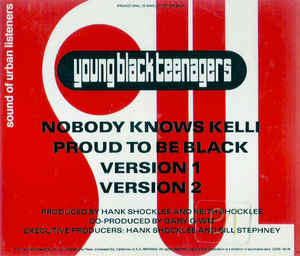
Not everything in hip-hop history makes immediate sense, and some of the things that don't make sense turn out to be the most interesting. Young Black Teenagers, a rap group that formed on Long Island, New York in 1989, were not young, debatably teenagers, and emphatically not Black. Every single member was white. They knew this. They named the group anyway. And rather than becoming a footnote in the history of cultural appropriation debates, they actually managed to score a genuine chart hit, release two albums, and earn the backing of one of the most politically charged acts in the entire history of hip-hop. That contradiction alone is worth sitting with for a minute.
The Name That Made People Stop in Their Tracks
Let us address the obvious thing first, because the obvious thing is genuinely interesting. DJ Skribble, born Scott Ialacci in Queens in 1968, Kamron (Ron Winge), First Born, Tommy Never, and ATA (Rodney) were the five members of Young Black Teenagers. None of them were Black. The group were aware that the name would land differently depending on who was reading it, and they were open about their intention: it was meant as a tribute to the Black culture that had shaped them, the music they grew up on, the community that built hip-hop from the ground up.
Whether that reads as respectful homage or breathtaking audacity probably depends on when you encountered it and where you were standing. In 1989, debates around cultural ownership in hip-hop were already live and raw. Public Enemy were releasing music that was explicitly about Black identity and political resistance. Against that backdrop, a group of white kids from Long Island choosing a name like Young Black Teenagers was never going to pass without comment. Some people found it ridiculous. Others found it offensive. The group essentially decided the conversation was worth having anyway.
The Public Enemy Connection
What gave Young Black Teenagers genuine credibility, at least within the industry, was who backed them. Public Enemy and their producer Hank Shocklee did not merely offer an endorsement. Shocklee signed the group as the very first act on his own record label, SOUL Records, where SOUL stood for Sound of Urban Listeners. That is a meaningful gesture of faith, not just a casual cosign. Shocklee was, at that point, one of the most respected and innovative producers in rap music, responsible for the dense, chaotic sonic collages that made Public Enemy's records feel unlike anything else on the market.
Being the first signing on a label run by someone of that stature meant Young Black Teenagers were entering the industry through a side door that most acts would never even find, let alone get through. It also meant their music carried a stamp of authenticity that the name alone could never have provided. Public Enemy's world was one of confrontation, political awareness, and Afrocentric pride. The fact that Shocklee saw something in this group, despite everything about them being counterintuitive to that world, suggests the music itself had genuine substance.
The First Album and Its Sharp Edges
Young Black Teenagers released their self-titled debut album in 1991. The only single to chart was "Loud and Hard to Hit", which peaked at number 25 on Billboard's Hot Rap Singles chart. The other singles went nowhere commercially, but they are worth paying attention to because they reveal a group with both personality and nerve.
"Nobody Knows Kelli" was a song about Kelly Bundy, the fictional character from the Fox sitcom "Married... with Children." That is a strange subject for a rap record, but it fits a group that clearly enjoyed wrong-footing expectations. More striking still was "To My Donna", a direct attack on Madonna for lifting the rhythm track from Public Enemy's "Security of the First World" and using it on her massive 1990 hit "Justify My Love". That is not a safe target. Madonna at that point was one of the biggest cultural forces on the planet. Going after her publicly, by name, in a song, on your debut album, takes a particular kind of front. The song did not chart, but the statement it made was clear enough.
The Hit That Actually Arrived
Tommy Never left the group after the debut, reducing the lineup to four, with ATA taking on a more prominent vocal role. Then in 1993 came their second and final album, "Dead Enz Kidz Doin' Lifetime Bidz". The title alone tells you something about how the group saw themselves: unsentimental, slightly confrontational, and not particularly interested in softening their image for mainstream consumption.
The album peaked at number 158 on the Billboard 200 and number 56 on the R&B Albums chart. It was the lead single that became their genuine moment. "Tap the Bottle" reached number 55 on the Billboard Hot 100, hit number 6 on Billboard's Hot Rap Singles chart, and number 73 on the Hot R&B Singles chart. It stayed on the charts for 20 weeks. That is not a fluke. That is a song that genuinely connected with people, whatever they thought of the group's name or backstory. The follow-up single "Roll with the Flavor" reached number 22 on the Hot Rap Singles chart, which suggests the group had real momentum heading into what should have been their third album.
The Shelved Third Record and the Quiet End
The third album never happened. A conflict between the group and their management and producer brought everything to a halt, the record was shelved, and by 1994, Young Black Teenagers had disbanded. It is the kind of ending that happens constantly in the music industry, particularly to acts who exist in a slightly awkward commercial space, not quite mainstream enough to survive label politics, not quite cult enough to keep going independently. There is a version of this story where that third album comes out and we are talking about a group with a proper discography. Instead they dissolved, and most of the world forgot they existed.
The contrast with what the members went on to do is striking. DJ Skribble built a long career as a DJ, working at radio stations Hot 97 and WKTU, appearing on MTV, and eventually becoming a resident DJ at the MGM Grand in Las Vegas. Kamron became co-founder of a production company called the Marksmen in Manhattan, doing music for films, commercials, and video games, and working with artists including Ice Cube, 50 Cent, and Jill Scott. He also went on to work as a senior audio engineer at Geejam Studios. Tommy Never, who had left even before the group split, worked with Clivillés and Cole in The S.O.U.L. S.Y.S.T.E.M. and eventually ended up running a wealth management firm in New York. First Born opened a tattoo shop in Brooklyn called Ringleaderz Ink. ATA moved into management and clothing. Separately, they all landed on their feet. Together, they ran out of road far too early.
Why This Story Still Has Something to Say
Young Black Teenagers existed in a particular kind of tension that the music industry has never quite resolved. They were white artists who built their identity almost entirely out of a culture that was not theirs by birth, backed by the people who were most articulate about what that culture meant, and they produced at least one song that enough people genuinely liked to keep it on the charts for five months. [The craft of the 1990s](/uprise/culture/the-craft-review-cult-high-school-horror-a-reminder-of-the) was full of moments like this, where the decade's appetite for transgression produced things that were simultaneously questionable and genuinely interesting, sometimes at the same time.
The easy take is that they were an absurdity, five white kids from Long Island who named themselves something provocative and rode Public Enemy's credibility for a couple of albums. The harder, more honest take is that the music did some of what they wanted it to. They paid genuine tribute to hip-hop at a time when plenty of white artists were lifting from the culture without acknowledging it at all. They called Madonna out publicly on a debut album. They got a top ten rap single. [The unfinished stories in music](/uprise/culture/the-stone-roses---wikipedia) are often the ones that tell you the most, and Young Black Teenagers, with their shelved third album and their abrupt 1994 ending, fit that description precisely. Awkward, contradictory, briefly brilliant, and then gone. That is a more interesting legacy than most acts who played it completely safe ever managed to build.