There's a particular kind of book that only gets written when someone has spent years doing the work nobody else bothered to do. Andrew Sacher's Emo Revival: Community, DIY, And Rebirth In Post-Hardcore And Emo (2008-2018) is exactly that. The BrooklynVegan staffer who spent years shining a torch on bands the mainstream music press couldn't be bothered with has turned that obsession into something permanent, and the excerpts doing the rounds right now confirm this is a serious piece of music writing.
Worth noting: BrooklynVegan was hit with massive layoffs by parent company Veeps just last month, alongside Alternative Press, Revolver, and Goldmine. The timing is grim. Sacher is continuing his work on Substack, which is something, but losing that platform stings. The book lands next week, and it feels more significant because of it.
What The Joyce Manor Section Tells Us
The excerpt doing the rounds centres on Joyce Manor, and it's the kind of detail-rich storytelling that makes music history actually readable. We get Barry Johnson admitting he initially dismissed Algernon Cadwallader as "just Cap'n Jazz" before a tour changed his mind entirely. We get Joe Reinhart, halfway through Joyce Manor's first song at the Ché Café in San Diego on 4 January 2011, thinking "Holy shit." That's the kind of moment that defines a scene, and Sacher captures it without overselling it.
The recording story is even better. Joyce Manor went into the studio with roughly 800 dollars, tasked with making an impression as the only non-hardcore band on hardcore label 6131. They treated the album like a greatest hits of a band who'd barely been heard, re-recording EP favourites and cutting new material. The production was meant to channel Pinkerton. Barry hated the result initially, thinking it should sound more like Weezer's Blue Album. Instead it sounded like a band playing in a basement, which is precisely why people loved it.
"Often what you're trying to do, you're better off having missed the mark because that's exactly what people are enjoying about it," Barry says in the excerpt. That's a line worth writing on a wall somewhere.
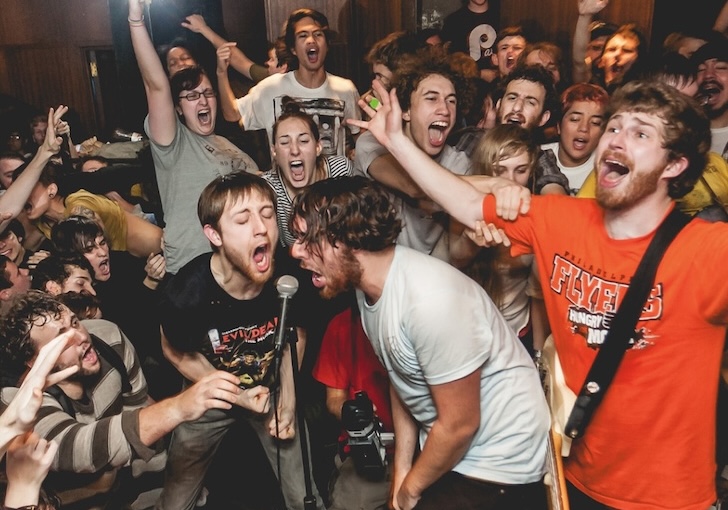
"Constant Headache" gets the treatment it deserves too. Written on a bus with no paper to hand, Barry nearly too scared to show it to anyone, worried people would laugh. Three minutes four seconds long, the biggest song in the band's early catalogue, written almost by accident. The release show in Bell Gardens, California on 15 January, with the album only streamable for eleven days, already had people screaming the bridge back louder than the band. Deafheaven also played that show, as the opening act, which in hindsight is a sentence that sounds completely made up.
Why This Book Matters
We're not short of music books that treat scenes as backdrop for one or two famous names. What Sacher appears to be doing is the opposite, building upward from the community itself, from the Ché Cafés and the 800-dollar recording budgets and the mutual admiration between bands who were all still figuring it out. If you're into this corner of music, and even if you're adjacent to it through a love of [lo-fi guitar-pop that carries its influences honestly](/uprise/music/toner-announces-new-album-dynasty-house-hear-cleo) or [DIY-coded punk](/uprise/music/piss-announce-new-album-you-made-me-skin-on-linen), this is worth your attention.
The book is out next week. Read it.