Picture a city in 1979. Disco is collapsing. A disc jockey who lost his job when his radio station went all-disco has just detonated a crate of records at a baseball stadium in front of 59,000 people, left a crater in the centre field at Comiskey Park, and triggered a riot so bad the White Sox had to forfeit the second game of a doubleheader. The anti-disco movement had found its moment of maximum absurdity, and somewhere in the wreckage, something genuinely extraordinary was beginning to take shape. Because when the mainstream decides something is over, the underground does not mourn. It builds.
The Name on the Wall
The exact origin of the word "house" is one of those pleasingly unresolved arguments that music history tends to throw up. What we do know is that many people trace the name back to a nightclub on Chicago's South Side called The Warehouse. The story goes that Chicago record stores began labelling dance records as "played at The Warehouse" to attract the growing crowd of people obsessed with the sound coming out of that building. Over time, the phrase got shortened. House music. Two words that would eventually travel to every corner of the planet.
There is something fitting about a genre being named after a building rather than a person or a movement. It grounds house music in a specific, physical place. Not a manifesto, not a label executive's marketing pitch, not a magazine think piece. A room. A dancefloor. The Warehouse and places like New York's Paradise Garage were not just venues; they were the infrastructure of a culture that existed entirely outside the mainstream's line of sight, and that invisibility was precisely what gave it strength.
Where Disco Left Off
To understand house music, you have to understand what disco actually was before the mainstream got its hands on it. Disco did not begin as a Saturday Night Fever soundtrack. It began in the early 1970s as an underground movement born in New York City's urban gay culture, built predominantly by LGBTQ, African American, and Latino communities. These clubs were not just entertainment. They were shelter. Places where people who faced real social hostility outside could lose themselves in music without looking over their shoulders. That context matters enormously, and it is a context that never fully disappeared when disco crossed over.
When disco did cross over, it crossed over hard. Major record labels piled in. The charts were flooded. And then came the backlash, which was not quite as ideologically neutral as "people got tired of disco" tends to suggest. Many people at the time, and many historians since, have pointed out that the anti-disco movement carried unmistakable currents of racism and homophobia. The communities that built disco were not the ones demanding its demolition. Disco Demolition Night on 12 July 1979, with its 98-cent entry fee and its dynamite and its triumphant crater, was a spectacle that said something very specific about who certain people thought popular culture was supposed to serve.
The Godfathers in the Booth
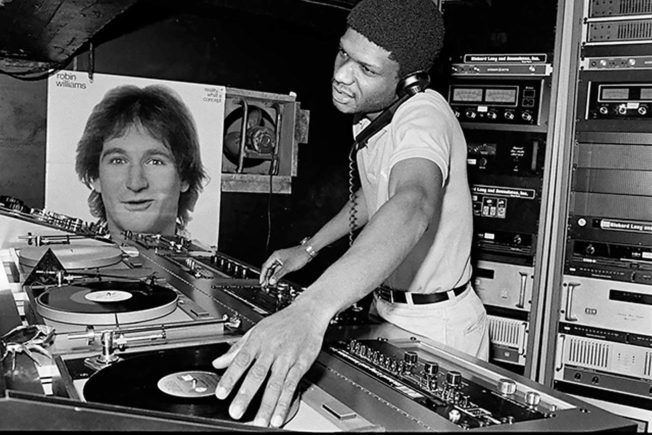
Into that landscape stepped a group of DJs who would reshape what it meant to make music for a dancefloor. Frankie Knuckles, Larry Levan, and DJ Ron Hardy are the names that anchor this story, and their contribution went well beyond spinning records. These were people who had no choice but to innovate, in part because they were working with inadequate equipment. Many early DJs lacked basic tools: no proper mixer, no headphones, no turntables with consistent speed control. The limitations forced creativity.
Frankie Knuckles, widely referred to as the Godfather of House, is probably the most illustrative example of what that creativity looked like in practice. He was reworking records on a reel-to-reel tape machine, adding percussion breaks, rearranging song structures, extending the sections that made people move. He was pulling from disco, funk, soul, and electro-pop and building something new from the pieces. This was not a studio process. It was a live, instinctive, dancefloor-driven art form, and the people in the room were the critics whose response mattered.
The Machines That Made It Modern
What turned this experimental club craft into a genre capable of spreading globally was the arrival of affordable technology. Synthesisers, samplers, sequencers, and drum machines dropped in price during the early 1980s, and suddenly bedroom producers existed. The implications of that shift are hard to overstate. You no longer needed a major label budget or studio access to make music that could move a room. You needed a machine and an idea.
The Roland TR-808, the TR-909, and later the TB-303 became iconic for good reason. The consistent 4/4 pulse that drum machines introduced gave house music its spine, the thing that makes it immediately identifiable even now. Producers started looping basslines, layering percussion, adding effects and vocals, building tracks from the ground up rather than remixing what already existed. By the mid-1980s, Chicago's Trax Records on North Clark Street was releasing records that defined what the genre could be: Marshall Jefferson's "Move Your Body," Phuture's "Acid Tracks," Larry Heard's "Can You Feel It," Frankie Knuckles' "Your Love." These were not pop songs. They were blueprints.
Body, Movement, Identity
House music also did something that tends to get underplayed in the technical history: it created its own physical vocabulary. The "jack" or "jacking" was one of the first dancing styles to emerge directly from the music, and it left its mark on the culture in a very literal way. Record titles named themselves after it. "Time to Jack" by Chip E, "Jack n the House" by Farley Jackmaster Funk, "Jack Your Body" by Steve Silk Hurley. The dance was not just a response to the music; it was woven into the identity of the whole scene.
That connection between music and movement is part of what made house culture so resilient. It was not passive listening. It was a physical, communal experience that carried real meaning for communities that had been building underground dance culture since the disco era. [How rave culture later took these ideas and ran with them across an entire continent](/uprise/culture/the-spread-of-the-rave-scene-to-other-cities) is a story of direct lineage. The warehouse party, the unlicensed space, the communal dancefloor: none of that appears out of nowhere in late-1980s Britain. It has roots, and those roots run straight back to Chicago's South Side.
From Underground to Everywhere
By the mid-1980s, house music had spread beyond Chicago to Detroit and New York, and each city gave it a different shape. Subgenres multiplied. Deep house went inward, atmospheric and soulful. Acid house twisted the TB-303's bassline into something alien and euphoric. The music was evolving faster than most genres manage in a decade. And the cultural ripple effects extended far beyond electronic music. House influenced pop, hip-hop, and the basic structure of how modern dance music is made and consumed. The producer-as-artist status that we now take for granted has direct ancestors in the Chicago DJs who merged the roles of performer, composer, and remixer into one job in the early 1980s.
It is also worth sitting with the political dimension for a moment, because it does not disappear just because the music became popular. [Screamadelica](https://www.getohedz.com/uprise/culture/primal-scream---screamadelica-the-rock-box) exists in part because house music arrived in Britain and met rock music at an extraordinary cultural moment. But the original house scene was built by and for communities who were marginalised, and that fact shaped everything about what the music did and how it sounded. The euphoria was real, but it was not accidental. It was the sound of people creating joy in a world that was not always keen on providing it.
Why It Still Matters
House music is now over four decades old and it has not stopped. That is not something you can say about many genres. The infrastructure it built, the culture it created, the technology it helped popularise, and the communities it brought together have all left marks that are still visible everywhere you look in modern music. The next time you hear a 4/4 kick drum in a pop song, or watch a DJ get treated like a headlining act, or see a dancefloor do what a dancefloor does, you are looking at the legacy of a sound that was born from rejection and built something that outlasted everyone who thought they could kill it.
The Disco Demolition Night crater at Comiskey Park got fixed. The music that rose from that moment never really needed fixing at all.