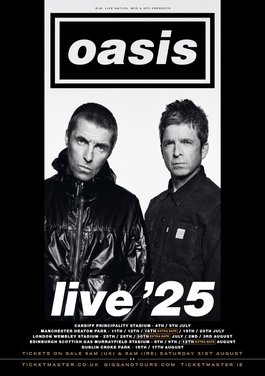
Fifteen years of public sniping, two solo careers, one catastrophically expensive divorce, and approximately ten thousand passive-aggressive interviews later, Liam and Noel Gallagher shared a stage again. The Oasis Live '25 Tour, which kicked off on 4 July 2025 at Principality Stadium in Cardiff and wrapped on 23 November 2025 at Estádio do Morumbi in São Paulo, was not just a concert tour. It was a cultural event so large, so chaotic, so genuinely polarising that it consumed almost every conversation in Britain for the better part of a year. It grossed $525 million. It was attended by over two million people. And it started with a ten-second video nobody was officially expecting.
The Teaser That Broke the Internet First
By the summer of 2024, the reunion rumours had been building for months, timed, as these things tend to be, around a milestone. The 30th anniversary of Oasis's debut album, Definitely Maybe, was approaching, and the tabloids were doing what the tabloids do. Liam batted away the speculation publicly, but his denials got progressively less convincing as the weeks went on, the kind of deflections that practically confirm what they claim to deny.
Then, on 25 August 2024, a ten-second teaser appeared. It ran at the end of Liam's headline set at Reading Festival, and simultaneously at Blossoms' show at Wythenshawe Park in Manchester. Within moments it was on the band's social media profiles and on both brothers' accounts. Ten seconds. No names, no dates, no statement. Just enough to make fourteen million people briefly lose their minds.
It is worth stopping on that number, because it is almost impossible to process. Around 14 million people are estimated to have thrown themselves into the scramble for 1.4 million tickets for just 17 shows. That is a demand-to-supply ratio that would make a housing economist weep. The announcement itself landed two days later, on 27 August 2024, two days before the anniversary of Definitely Maybe, with initial dates confirmed for five nights each at Wembley Stadium and Heaton Park in Manchester. The reunion was real, and the country duly lost its head.
What Ticketmaster Did to the Nation's Goodwill
If the announcement was euphoric, the ticket sale was the comedown nobody wanted. General sale opened on 31 August 2024, and within hours it had become a national grievance. Queue times stretched into hours. Fans were flagged as bots. Server errors piled up. And then came the dynamic pricing, which transformed the simple joy of buying a ticket into something that felt more like a financial ambush. Standing tickets had been listed at around £150, with premium packages running up to £506 during the presale. By the time the general sale was in full swing, resellers had already listed tickets for the 26 July show at £6,000 a piece.
Three extra dates had been announced just two days after the initial confirmation, on 29 August 2024, in direct response to demand. And to their credit, when the band eventually expanded the tour to North America, Australia, South America and Asia, dynamic pricing was not used for those legs. But the damage to the optics of the UK rollout was already done. The Gallaghers had always positioned themselves as working-class lads who spoke for regular people. Watching regular people get priced out of seeing them by a ticketing algorithm was not a great look.
The Cultural Backlash Was as Oasis as Oasis Ever Got
Every major Oasis moment comes with a fight attached, and this was no different. The Guardian called the band "the most damaging pop-cultural force in recent British history". Columnists lined up to take shots at the laddish legacy of the nineties, at the bucket hats, at the football-terrace energy, at the demographic of the fanbase. There was a peculiar debate, genuinely unpleasant to witness, about whether younger female fans deserved to attend at all, which prompted Noel's daughter Anaïs Gallagher to call out the ageism and sexism baked into that argument. She was not wrong.
The Independent, meanwhile, suggested that people worried about the brothers coming to blows on stage might redirect their concern toward the broader culture of male violence the era had normalised. Barbara Ellen at The Guardian noted, drily, that within four days of the announcement the band had been blamed for everything from bad haircuts to the collapse of nineties music culture. She compared the fuss to the Sex Pistols' 1996 Filthy Lucre Tour, which is the kind of comparison that either damns you or crowns you, depending on your point of view.
What the backlash missed, as backlashes often do, is what it actually felt like to love Oasis. We wrote about exactly that dynamic in our piece on [Britpop Was Never Just Blur vs Oasis. It Was So Much Bigger.](/uprise/culture/blur-v-oasis-was-only-part-of-the-story-the), and it is worth revisiting: the band were never just about nostalgia for the people who were there. They were a specific feeling, a specific proposition, that music could be enormous and communal and yours all at once.
The Economics Were Staggering, and Not All of Them Were Pretty
Some of the numbers that surrounded this tour were remarkable for all the right reasons. Manchester's nightlife economy adviser Sacha Lord estimated that the reunion could bring £15 million into the region. The tour ultimately grossed almost £397.7 million, making it the second-highest-grossing tour of 2025. Over two million people attended across 41 concerts in 14 countries. By any measure, that is extraordinary.
But the economics also had a grubby edge. The Maldron Hotel chain in Manchester was accused of cancelling existing bookings so rooms could be resold at higher prices. They claimed overbooking. Nobody was particularly convinced. In Edinburgh, where two of Scotland's dates were scheduled, Live Nation UK drew anger from housing activists and politicians for placing shows during the Edinburgh Festival Fringe, when the city's hotels and short-term lets are already stretched to breaking point. The reunion enriched some people very handsomely. It was not always the people it was supposed to enrich.
The Music Made the Argument They Couldn't
While everyone was arguing about laddism and dynamic pricing, the music quietly made its own case. On 30 August 2024, the day before general sale opened, six Oasis releases re-entered the UK charts. "Live Forever" peaked at number eight, a new high for the track, which had only managed number ten on its original release in 1994. Definitely Maybe eventually hit number one the following week, bolstered by its 30th anniversary re-release. People were not streaming these songs ironically. They were streaming them because they still work.
The support acts chosen for the tour reflected a specific taste and a genuine generosity toward their peers. Cast and Richard Ashcroft handled the UK nostalgia circuit, while Cage the Elephant, Ball Park Music, Asian Kung-Fu Generation, and Otoboke Beaver gave the international dates a genuinely exciting range. This was not a heritage act coasting on atmosphere. There was thought behind it. For a band whose reunion had been framed as pure commerce and ego, that mattered.
If you want context for how much the Manchester musical lineage feeds into something like this, our piece on [How Rave Culture Escaped Manchester and Took Over Everything](/uprise/culture/the-spread-of-the-rave-scene-to-other-cities) maps exactly how that city has made the world's musical weather, repeatedly and on its own terms.
What Comes After You Break Every Record
The tour ended in São Paulo in November 2025. By May 2026, a book of 1,000 photographs from the tour by Simon Emmett had been published. A documentary, Oasis: Don't Look Back in Anger, premiered on 5 September 2026. Nine days after that, the Oasis Live '27 Tour was announced. So here we are.
The question everybody is dancing around is whether any of this changed anything or whether it was simply the largest and most expensively mounted act of nostalgia Britain has ever produced. Keir Starmer welcoming the reunion at a press conference, and then name-checking "the swagger of Oasis" at the 2025 Labour Party Conference, is either the most perfect endorsement possible or the clearest evidence that the band now belongs entirely to the establishment they once defined themselves against. Possibly both. With Oasis, the contradictions were always part of the deal.
What we know for certain is this: two brothers who had not shared a stage since August 2009 came back, played 41 shows across 14 countries, were attended by over two million people, and sparked arguments that felt, genuinely, like arguments worth having. The [Britpop Was a Boys' Club](/uprise/culture/rough-trade-essential-britpop) debate resurfaced. The laddism conversation resurfaced. The question of who music is for and who gets priced out of it resurfaced. None of those debates were resolved. But that is what the best bands do: they force the conversation whether you want to have it or not. Oasis were back. Britain had absolutely no idea what to do with them. Same as ever.