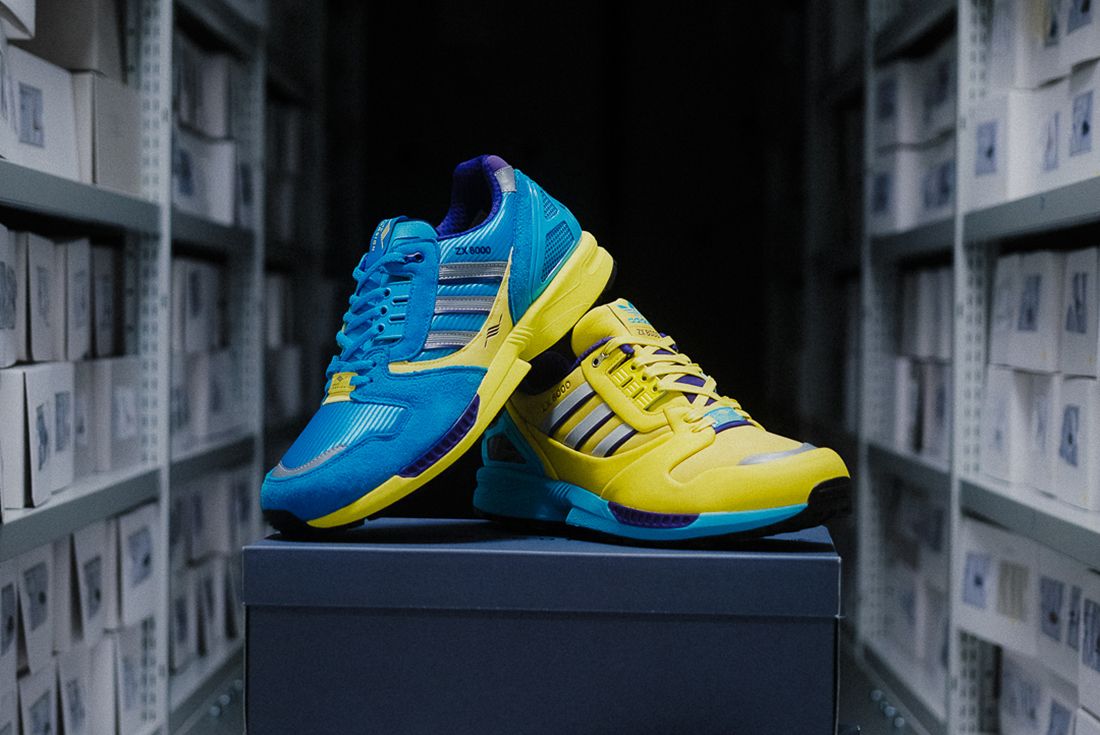
There is a certain type of trainer that earns its reputation not through marketing but through presence, through being in the right place at enough of the right moments that history essentially adopts it. The adidas ZX 8000 is that shoe. Launched in 1989, it arrived into a world that was literally cracking apart at the seams: walls coming down in Berlin, warehouses filling with smoke and strobe light in Manchester, a generation of young people building identity out of whatever they could get their hands on. The ZX 8000 was something they could get their hands on, and they never really let go.
The System Behind the Silhouette
To understand the 8000, you have to go back to 1984, when adidas designer Jacques Chassaing launched the ZX series with a genuinely progressive idea at its core. Chassaing believed, sensibly enough, that different runners had different needs, and that a single performance shoe serving everyone was a compromise serving no one. So he and co-designer Markus Thaler built an architecture around that belief, splitting the range into training and competition silos, then subdividing further by biomechanical function: Cushion in blue, Support in yellow, Guidance in green, Racing in red. This was not branding for its own sake. It was a functional taxonomy, a colour-coded system that told the buyer exactly what they were putting on their feet.
The numbering followed the same logic, running upward from the ZX 500 and ZX 800 in the mid-1980s before climbing into four digits by the end of the decade. By the time the 8000 arrived, the series had built enough technological momentum to make that number feel like a destination rather than an arbitrary point on a scale. When you hit the ZX 8000, you knew you were at the top of something.
The Tech That Changed Running Shoes
The headline innovation of the ZX 8000 was the Torsion System, a lightweight TPU arch bridge that runs beneath the EVA foam midsole and allows the heel and forefoot to move independently of one another. This sounds simple enough described in a sentence, but the structural implication is significant. Previous running shoes treated the foot as a single rigid unit, supporting it uniformly across the sole. The Torsion System acknowledged that the foot is not rigid, that it rolls, twists and adapts with every stride, and that a shoe should work with that movement rather than against it.
The ZX 8000 was the first adidas shoe ever built with that system, and adidas has used it across its catalogue ever since. Alongside the Torsion bridge, the 8000 introduced Soft Cell cushioning in the heel, giving it a layered approach to impact absorption that was ahead of its time. The Aqua colourway, that distinctive combination of light aqua, lemon peel and violet, was not simply a fashion choice either: aqua sat within the blue Cushion category, which meant the colour was literally telling you what the shoe did. Function and aesthetics as the same sentence.
Raves, Warehouses and the Second Summer of Love
Here is where the story gets genuinely interesting, because the ZX 8000 was never supposed to be a rave shoe. And yet it became exactly that. In 1988 and 1989, huge warehouse parties were pulling thousands of young people across the north of England, and those people needed footwear that could handle a full night of dancing on concrete. The EVA midsole and Torsion System made the ZX 8000 practically ideal for that purpose, springy and supportive in equal measure. The Aqua colourway, vivid under UV light, was a perfect fit for the visual language of Acid House.
Adidas Consortium's George Griffin put it plainly in an interview with Highsnobiety: the second summer of love, 1988 to 1989, saw ravers in the north of England adopt the ZX precisely because it was comfortable enough to last all night, and because its colours were in tune with the whole Acid House aesthetic. You did not need a marketing campaign when the shoe was already doing the work on its own terms. The ZX also found its way into football casual culture during the same period, cementing its place in the broader subcultural wardrobe of working-class Britain. This was a shoe worn by people who had developed extremely sharp eyes for quality and authenticity, and it passed every test.
Berlin, the Wall and Eastern Europe
Meanwhile, on the other side of Europe, something equally significant was happening. The fall of the Berlin Wall in 1989 coincided almost exactly with the ZX 8000's release, and in the context of former East Germany, a pair of adidas ZX trainers was more than footwear. It was a signal. Sneakers filtered through via relatives and the black market, landing on streets and in cultural spaces entirely without advertising, and wearing them meant access to something limited and Western, a symbol of possibility in a period of enormous upheaval.
Marc Leuschner, the CEO of Berlin's Overkill store and a long-standing ZX collector, is one of the people who carries that history. His connection to the shoe is rooted in exactly that moment: the ZX arriving into a city that was rewriting itself in real time, becoming part of the visual language of a generation that had just been handed an entirely different future. Berlin's underground rave scene and the ZX 8000 would grow up together through the early nineties, making the shoe a fixture of one of the most culturally charged cities in the world.
The A-ZX Project and the Pair Nobody Could Buy
In 2008, adidas launched the A-ZX project, a global collaboration involving 22 of the world's leading sneaker retailers, from Wood Wood and Colette to HUF, Bodega and Foot Patrol. Each retailer colour-blocked their own ZX model, and the whole series ultimately comprised 26 pairs, one for each letter of the alphabet, celebrating both the heritage and the ongoing life of the ZX line. The first eight pairs dropped on 8 August 2008, a date that was clearly not chosen by accident.
To close the project, Chassaing and Thaler produced what remains one of the most mythologised sneakers adidas has ever made. Using a premium "stitch and turn" construction that left no exposed rough edges on the interior, they built a limited ZX 8000 that featured their own faces printed on the tongues. Only 22 pairs were produced, one for each collaborating retailer, with a competition winner receiving a pair as well. The shoes were never offered for sale and never reached the public market. To this day, speculation about the exact whereabouts of those 22 pairs, and what they might fetch if they ever surfaced, is a reasonable conversation to have in any serious sneaker community.
What It Still Means
The ZX 8000 has come back repeatedly across the decades, through mid-2000s reissues, the 2013 and 2020 Aqua colourway returns, and the 2014 launch of the ZX Flux, which stripped the 8000 back to its core DNA for a new generation. Collaborations with LEGO in September 2020 brought interchangeable brick lace jewels and co-branded sock liners to a silhouette that was already thirty years old. More recently, the "Made in Germany" JC & MT edition, named directly for Chassaing and Thaler, brought the shoe back in premium form, honouring the two designers at the root of everything. Thaler passed away in 2024, one of the last people at adidas who had worked directly alongside Adi Dassler himself.
What the ZX 8000's story tells us is that the best sports shoes do not stay in sports. They migrate, they get adopted, they accumulate meaning from the contexts they land in, and eventually they become cultural objects as much as functional ones. The ZX 8000 earned that status the hard way: by being genuinely useful on a warehouse dancefloor, by being a status symbol on the streets of post-Wall Berlin, by being the shoe that introduced Torsion to the world and changed how adidas thought about the human foot. We are still wearing it. That is not nostalgia. That is earned permanence.