There are moments in cultural history that, when you try to explain them after the fact, sound completely made up. Sixty-year-old psychedelia colliding with rave beats. Football shirts worn with the baggiest jeans humanly possible. A bucket hat elevated to near-religious headwear. MDMA flowing freely enough to dissolve whatever remained of post-industrial northern pessimism. And somehow, from all of that, one of the most singular music scenes Britain has ever produced. Madchester was not supposed to work. The fact that it did, spectacularly and briefly, tells you something important about what happens when a city reaches a particular kind of cultural boiling point.
Where the Word Even Came From
The name itself is worth unpicking, because the origin story is wonderfully chaotic in a way that suits the whole movement. Tony Wilson, Factory Records boss and the man most publicly associated with the Madchester myth, is often credited with coining the term. Wilson was the sort of figure who would absolutely want credit for something like that, and he was at the centre of everything: Factory Records, the Haçienda, a career in television at Granada that gave him the platform and the contacts to operate where music and culture met.
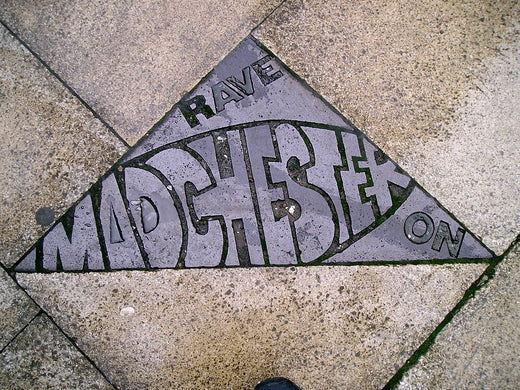
But the real story, the one passed around by people who were there, is that the Bailey Brothers came up with it first. The video directors were working with Factory and Happy Mondays and needed a word to describe Manchester in a film about car thieves, something that would sidestep any potential legal complications. Madchester was the workaround. Then Wilson took the word and told Happy Mondays to rename their second EP, shifting it from "Rave On" to "Madchester Rave On." That EP came out in November 1989. It included "Hallelujah," which broke the Top 20 and got the band their first Top of the Pops slot. From a legal fudge to a defining cultural label in less than a month. That is how these things happen.
The Haçienda at the Centre of Everything
You cannot talk about Madchester without talking about the Haçienda. Factory Records, the label that gave the world Joy Division, New Order, Happy Mondays, James, and more, ran the club in partnership with New Order. And the Haçienda was not simply a backdrop to the scene. It was the laboratory where the whole thing was assembled. The club was one of the first venues in the UK to play house music, and its regular house night Nude had the place full every night of the week by 1987. Then in 1988 they launched Hot, their acid house night, and that is the moment Madchester stopped being a local rumble and became something that genuinely rerouted British music.
Wilson's trajectory into all of this is its own story. He had been at the Sex Pistols gig at Manchester's Lesser Free Trade Hall back in June 1976. He saw something in that room that he clearly never forgot: the sense that a small gathering of people witnessing something raw could change everything that came after. Factory Records followed in 1978, and the label became the architecture through which a succession of Mancunian artists could exist on their own terms. The [history of house music](/uprise/culture/the-history-of-house-music-and-its-cultural-influence) reaching the Haçienda was not accidental. Wilson and his collaborators were actively pulling the future towards them.
Happy Mondays and the Human Face of the Scene
Shaun Ryder formed Happy Mondays at 18, alongside his brother Paul. That detail matters more than it might seem. Madchester was not a scene built by industry insiders or art school theorists. It came from people who had grown up in and around Manchester, who carried that Mancunian directness in everything they did. The drawl, the swagger, the refusal to take anything too seriously except the music and the night. As the source puts it, out went the sad baritones of Morrissey and Ian Curtis, and in came the Manc drawl of the Ryders and Ian Brown. That shift in tone was not cosmetic. It reflected a genuine change in what the city wanted to say about itself.
Happy Mondays and the Stone Roses are the twin pillars of the movement, and the Stone Roses' debut album remains one of the most celebrated British records ever made. They only recorded two albums in total. The weight that first record carries, the way it is still discussed and argued over, tells you everything about how fully formed it was. And the knock-on effects reached further than anyone could have predicted at the time. Noel Gallagher has credited the Stone Roses with inspiring him to become a musician. [What Oasis then became](/uprise/culture/oasis-live-25-tour---wikipedia) is the clearest measure of exactly how large a shadow those two Mancunian lads cast.
The Roster Was Wider Than You Think
One of the things that gets flattened in nostalgic retellings of Madchester is how broad the scene actually was. It was not just the Roses and the Mondays. 808 State formed in the Eastern Bloc record shop and broke the Top 10 with "Pacific State." Sub Sub, who later became Doves, were a dance act from Handforth in Cheshire who got to number 3 in the singles chart. The Charlatans have racked up 22 Top 40 singles and 13 Top 40 albums across a career that stretches to 2017 and beyond. These are not footnotes. These are substantial bodies of work.
Then there are the bands that make you question the geographic boundaries of the whole thing. The Farm came from Liverpool. EMF were from Gloucestershire. Candy Flip were from Stoke-on-Trent. World of Twist were getting played in New York and Toronto without ever having toured North America, their single "Sons of the Stage" reaching the US club circuit while barely scraping the UK charts. The fact that so many non-Mancunian acts were pulled into the Madchester orbit says something real: the scene was less a postcode and more a sensibility, a particular collision of sounds and attitudes that other people recognised and wanted to be near. [How that energy eventually spread beyond Manchester](/uprise/culture/the-spread-of-the-rave-scene-to-other-cities) is a whole other story, but Madchester was the engine that drove a lot of it.
The Weirder Details That Make It Real
Some of the best details about Madchester are the ones that sound apocryphal but hold up. There are allegedly 72 different versions of "Pacific State" by 808 State. The Mock Turtles were fronted by Martin Coogan, brother of Steve. Northside performed on Top of the Pops despite not having a single in the Top 40. The Wendys came from Edinburgh and were only brought to Tony Wilson's attention because Shaun Ryder's dad told them to send a demo tape. World of Twist's song title "Sons of the Stage" was apparently considered as a name for Oasis, and later covered by Beady Eye. The Real People from Liverpool let a young Oasis use their recording studio to make an eight-track demo.
These connections and coincidences are not trivial. They are the connective tissue of a scene, the web of relationships and lucky breaks and moments of generosity that meant things kept spreading outward. Scenes do not sustain themselves on talent alone. They need the infrastructure of people willing to pass things on, and Madchester had that in abundance. The Haçienda gave James a record deal after a gig in 1982. Factory gave the Wendys a shot because of a tip from someone's dad. This was community, operating at a pitch that occasionally produced greatness.
What It Actually Left Behind
The Madchester scene had a short, concentrated life. By the early 1990s it was already fading, overtaken by the next wave and by the particular exhaustion that follows any period of intense collective hedonism. But the legacy is not in doubt. A commemorative exhibition at Manchester's Science and Industry Museum. A Factory Records box set released in October 2019. The Stone Roses' debut still sitting on best-album lists. The Charlatans still on tour. Inspiral Carpets on the road in 2023. The High, the supergroup assembled in 1989 from former Stone Roses, Inspiral Carpets and Buzzcocks members, still active and releasing on Record Store Day.
What Madchester proved, and this is the thing worth holding onto, is that a music scene built on apparent contradictions can produce something entirely coherent. Psychedelia and rave beats should not sit together. Football casuals and indie kids should not share a dancefloor. Manchester in the late 1980s was not, on paper, the most obvious place for a cultural explosion. And yet. The [Stone Roses' story alone](/uprise/culture/the-stone-roses---wikipedia) is enough to make the case. Two albums, a movement, and a generation of musicians who cite them as the reason they picked up a guitar. Madchester was a beautiful accident, assembled from borrowed words, borrowed sounds, and the particular alchemy of a city that had decided it was done being miserable.